
Life & Property
When Health Changes the Meaning of Independence at Home
Independence isn't a single state — it's shaped by what a home allows, what support is available, and what a changing body can comfortably do. When health shifts, the question isn't whether to stay but what staying well actually requires.
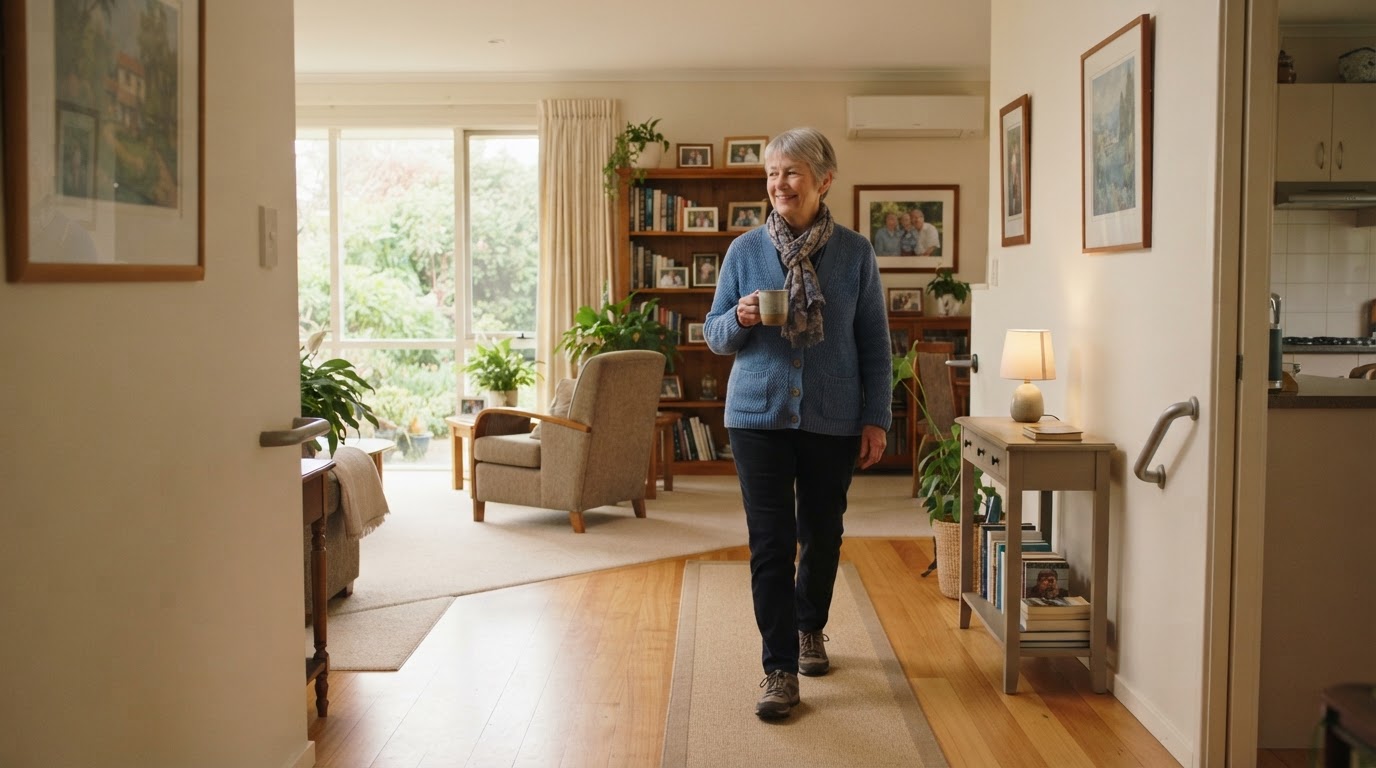
Independence at home sounds like a simple thing — you either live independently or you don't. But anyone who has watched a health or mobility change arrive knows it's nothing of the kind. Independence is shaped by what a home allows, what a body can comfortably do, what support is available, and what daily life actually requires. When health shifts, the meaning of independence shifts with it — and the question isn't whether to stay but what staying well, safely, and sustainably actually requires. That question deserves a more honest answer than 'can I still live here,' because a home can technically be livable and practically be eroding an independence that adaptations or support could preserve.
What independence at home actually depends on
The practical question is whether the home supports the daily functions that make independent life possible — and that breaks into a few honest pieces.
The physical environment
Stairs, bathing, entryways, flooring, and reach all determine whether a home works for the body living in it. A change in mobility can turn a familiar layout into a daily obstacle course — not because the house changed, but because the person did. The Centers for Disease Control and Prevention identifies falls as the leading cause of injury among adults age 65 and older, and the National Institute on Aging offers concrete guidance — lighting, secured rugs, grab bars, nonslip surfaces — for reducing those risks at home. Understanding which risks are reasonable to address and which reflect a deeper mismatch between the home and the body is often the first practical question.
Daily functioning
Independence isn't only about moving through the house. It's about whether a person can manage the ordinary activities a home requires — cooking, cleaning, maintaining, getting to appointments, managing the household's needs. A health change can make tasks that were once effortless into daily friction, and that friction, accumulated, can quietly erode the independence it sits inside of. Recognizing it isn't admitting defeat. It's seeing the situation clearly enough to choose a response.
Available support
What a person can do alone and what they can do with support are different questions, and the second one changes what's possible. In-home help, maintenance services, family nearby, transportation, or a community that provides what a single home can't — all of these can extend the independence a property supports without requiring a move. A home's suitability isn't only about the house. It's about the network around it.
Staying well, not just staying
The most important distinction here is between staying and staying well. It's possible to remain technically in a home while daily life becomes increasingly circumscribed — one floor avoided, one room unused, one task quietly abandoned. That's not independence preserved; it's independence narrowed, sometimes without anyone noticing. The honest question is whether the home, as it is or as it could reasonably be made, supports the full life the person wants to live — or whether it's slowly reducing that life to the parts the house can still accommodate.
“The goal isn't to stay at any cost. It's to stay well — in a home that supports the life being lived in it, not just the body standing in it.”
The options, and what each preserves
- Adapt the home — grab bars, a stairlift, a first-floor arrangement, better lighting — to make the existing layout work with changing needs.
- Bring in support — in-home care, maintenance services, transportation — to extend what the household can manage without leaving.
- Reorganize daily life around the parts of the home that still work well, and reduce reliance on the parts that don't.
- Move to a property — single-level, lower-maintenance, closer to support — that better supports independence over the longer horizon.
- Stage the decision — adapt now, plan for what may come, and move only if and when the home can no longer support the life the person wants.
None of these is the 'right' answer, and most aren't mutually exclusive. The right one is the one that keeps the person — not the house — at the center of what independence means.
Questions worth asking
- What does daily life in this home actually require, and how much of that still matches what the body and circumstances can comfortably provide?
- Could reasonable adaptations — to the home or to the support around it — extend independence without a move?
- Is the independence the home supports narrowing, and is that being noticed before it becomes a crisis?
- What would a property that better supports independence look like — and what would it cost or give up?
- What does the person living here most want to preserve about their independence, and which option protects that?
This article provides general educational information, not individualized medical, healthcare, or rehabilitation advice, nor legal or financial advice. Accessibility, care, and property decisions should be evaluated with appropriately qualified professionals — including healthcare providers, occupational or physical therapists, and legal and financial advisors — based on individual circumstances.
Related paths
These Jumpcity capabilities may be relevant to this situation.
AI tools were used in preparing this article. Jumpcity is responsible for its published content.
Continue exploring
Guides & Tools for Your Next Step.
Explore practical resources to understand your options, compare tradeoffs, and prepare for what comes next.
Property Readiness Audit
Identify property conditions, access needs, missing information, and questions requiring professional review before deciding what comes next.
Open the ChecklistWhen Repairs or Property Problems Complicate a Move
Organize condition concerns, missing information, and the questions that need a professional.
Read the GuideFamily Transition Planner
Center the parent's preferences, responsibilities, and timing in one shared place.
Open the PlannerIs It Time to Downsize?
Explore lifestyle fit, housing expenses, and the difference between equity and cash after a move.
Read the GuideRelated insights
When the Home You Love No Longer Fits the Life You're Living
The home that once made life easier can gradually become harder to live in. When that happens, the question isn't always whether to sell — it's whether the home can continue supporting the life you want to live.
When Caring for a Parent Changes Your Own Housing Plans
Becoming a caregiver can reshape the caregiver's housing as much as the parent's. Combining households, moving closer, or adapting a property — each carries its own costs, logistics, and boundaries.
When an Inherited Home Becomes a Family Decision
An inherited property often becomes a question for everyone who shares it. Ownership, memories, costs, and different ideas about the future all arrive at once — and the first useful step is rarely a sale.
Useful context is worth sharing.
Not sure which path fits your situation?
What Happens After You Start
You share your situation. Complete the assessment — about three minutes, no obligation.
A person reviews it. Someone at Jumpcity reads what you shared to understand your goals.
We follow up with context. We reach out with relevant options and an appropriate next step.
A short, guided assessment · No obligation
A Path for Every Move.