
Life & Property
When Caring for a Parent Changes Your Own Housing Plans
Becoming a caregiver can reshape the caregiver's housing as much as the parent's. Combining households, moving closer, or adapting a property — each carries its own costs, logistics, and boundaries.
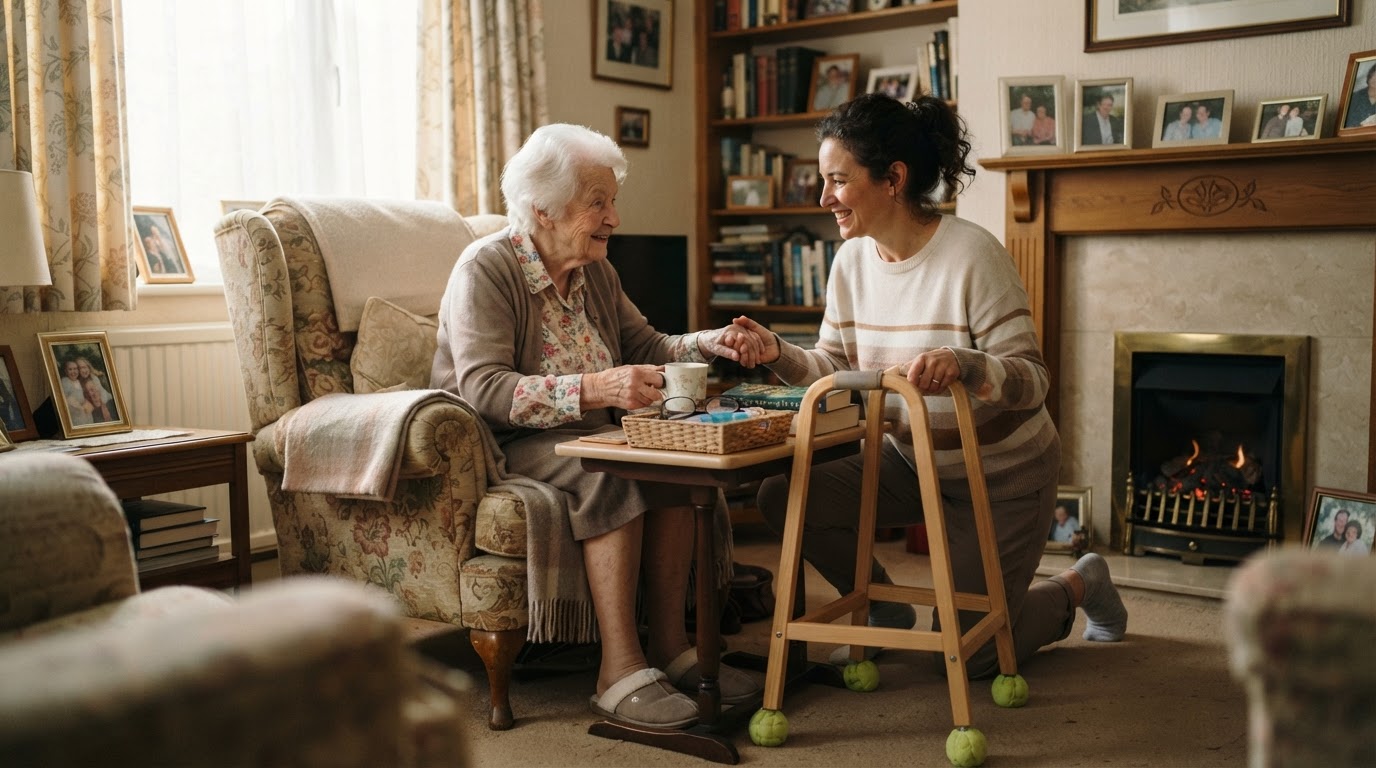
Most conversations about an aging parent's home focus on the parent. But the moment an adult child becomes a caregiver, a second set of housing questions tends to arrive — the caregiver's own. Because caring for someone often means the caregiver's living situation has to change too: to be closer, to combine households, to adapt a property, or to rearrange a life around needs that weren't there before. And those decisions are made harder by the fact that they're made in the middle of an already-demanding responsibility, by someone who is usually also managing a job, a household, and a family of their own.
The caregiving arrangement is also a housing decision
Caregiving rarely comes with a single, obvious housing answer. It shows up as a set of options, each with its own tradeoffs, and each shaped by the specifics of the parent's needs, the caregiver's life, and the distance between them.
Moving closer
For a caregiver living across town or across the country, proximity may become the central question. Being closer can make daily support possible — dropping in, managing appointments, being present for the ordinary needs that add up. But it also means uprooting the caregiver's own household: a different commute, a different community, sometimes a different cost of living, and the disruption of a move undertaken not for the caregiver's preferences but for the parent's needs.
Combining households
Sometimes the answer is one home instead of two — a parent moving in, or the caregiver moving into the parent's home. It can be the most direct way to provide care, and it can preserve a parent's rootedness in a familiar place. But it also merges two established households, two sets of routines, and often two generations' expectations about privacy, independence, and how daily life works. A combined household works best when the boundaries — financial, spatial, relational — are agreed in advance rather than discovered under pressure.
Adapting a property
Whether the parent stays in their own home or joins the caregiver's, the property itself may need to change. A first-floor arrangement, an accessible bathroom, a separate entrance, or a layout that allows both privacy and proximity can make caregiving sustainable rather than exhausting. Adaptation can be less disruptive than a move, but it has its own limits — not every property can be practically adapted, and not every budget can absorb it.
Arranging support without relocating
And sometimes the right answer isn't a move at all. Outside services, in-home support, or coordinated help from siblings can change what a property asks of the people living in it. For some families, the right arrangement is the one that lets the parent stay and the caregiver's own life stay intact — supported, rather than restructured.
“The caregiving decision is rarely just about the parent's house. It's about what both households — the parent's and the caregiver's — can sustain together.”
The cost of the caregiver's own life
What's easy to underestimate is the weight these decisions place on the caregiver's own housing, finances, and time. A move undertaken for a parent's needs may mean a longer commute, a higher cost of living, or a step back from a community the caregiver valued. A combined household may mean the caregiver's own family adjusts to a new routine. And the financial picture — who pays for what, how costs are shared, whether a parent's equity or the caregiver's income carries the arrangement — deserves the same honest attention as the care itself. A caregiving plan that works for the parent but exhausts the caregiver isn't a plan that works.
Questions worth asking
- What does the parent actually need — and what would it take to provide it, in time, proximity, and property?
- What does the caregiver's own household need to stay sustainable — and which arrangements protect it rather than strain it?
- If the answer is a move, whose move is it, and what does it cost the person making it?
- Could the current home — either one — be adapted to make care more manageable without a relocation?
- What support — family, services, or professional help — could change what the property needs to provide?
This article provides general educational information, not individualized healthcare, legal, tax, or financial advice. Caregiving, housing, and benefits decisions should be evaluated with appropriately qualified professionals based on individual circumstances.
A Worksheet for the Household You’re Considering.
Before a shared household settles in, the practical questions are easier to answer than after. Use this worksheet to organize what each person needs from the space, how the household’s costs would be shared, and which questions are still open. Nothing you enter is sent or stored — it stays on this page for you to think with.
Household Space & Expenses Worksheet
Organize the practical questions a shared household raises — space and privacy, shared expenses, and the open questions worth naming before the arrangement settles in. Organizational only; nothing is sent or stored.
Your worksheet
Updates as you enter values. Nothing is sent or stored.
Estimated monthly shared expenses
$0/mo
0 of 0 expenses entered. Your estimates — not a budget or a determination of what anyone can afford.
Space & privacy
0 needs
0 essential · 0 important
Open questions
0 open
0 resolved · 0 discussing
What this worksheet is — and isn't
An organizing tool, not a determination of affordability, ownership, capacity, or authority. The expense figures are your estimates, not a verified budget. Space needs reflect what matters to your household, not what any particular property can provide. Housing, financial, and care decisions deserve appropriately qualified professionals — this worksheet helps you arrive at those conversations organized.
Related paths
These Jumpcity capabilities may be relevant to this situation.
AI tools were used in preparing this article. Jumpcity is responsible for its published content.
Continue exploring
Guides & Tools for Your Next Step.
Explore practical resources to understand your options, compare tradeoffs, and prepare for what comes next.
Helping a Parent With Their Next Move
Explore a parent's housing preferences, support needs, property responsibilities, and family considerations before planning their next move.
Read the GuideFamily Transition Planner
Center the parent's preferences, responsibilities, and timing in one shared place.
Open the PlannerPlanning a Move Between States
Understand how your current home, next home, financing, and timing connect when a move crosses state lines — and how to approach the decisions without assuming a sale or a sequence.
Read the GuideSale Readiness Planner
Organize the decisions, documents, preparation tasks, and timing involved in getting a home ready to sell.
Open the PlannerRelated insights
When an Aging Parent's Home Becomes a Family Concern
It often starts with a small worry — a fall, a cluttered stairway, a house that's harder to keep up. How can a family help while respecting a parent's independence and the home they've built?
When Adult Children Move Back Home
A household that was once full and then quiet can become full again. When adult children return, the home has to fit a different kind of family — and the questions that follow are practical, financial, and human.
When the Home You Love No Longer Fits the Life You're Living
The home that once made life easier can gradually become harder to live in. When that happens, the question isn't always whether to sell — it's whether the home can continue supporting the life you want to live.
Useful context is worth sharing.
Not sure which path fits your situation?
What Happens After You Start
You share your situation. Complete the assessment — about three minutes, no obligation.
A person reviews it. Someone at Jumpcity reads what you shared to understand your goals.
We follow up with context. We reach out with relevant options and an appropriate next step.
A short, guided assessment · No obligation
A Path for Every Move.