
Life & Property
When an Aging Parent's Home Becomes a Family Concern
It often starts with a small worry — a fall, a cluttered stairway, a house that's harder to keep up. How can a family help while respecting a parent's independence and the home they've built?
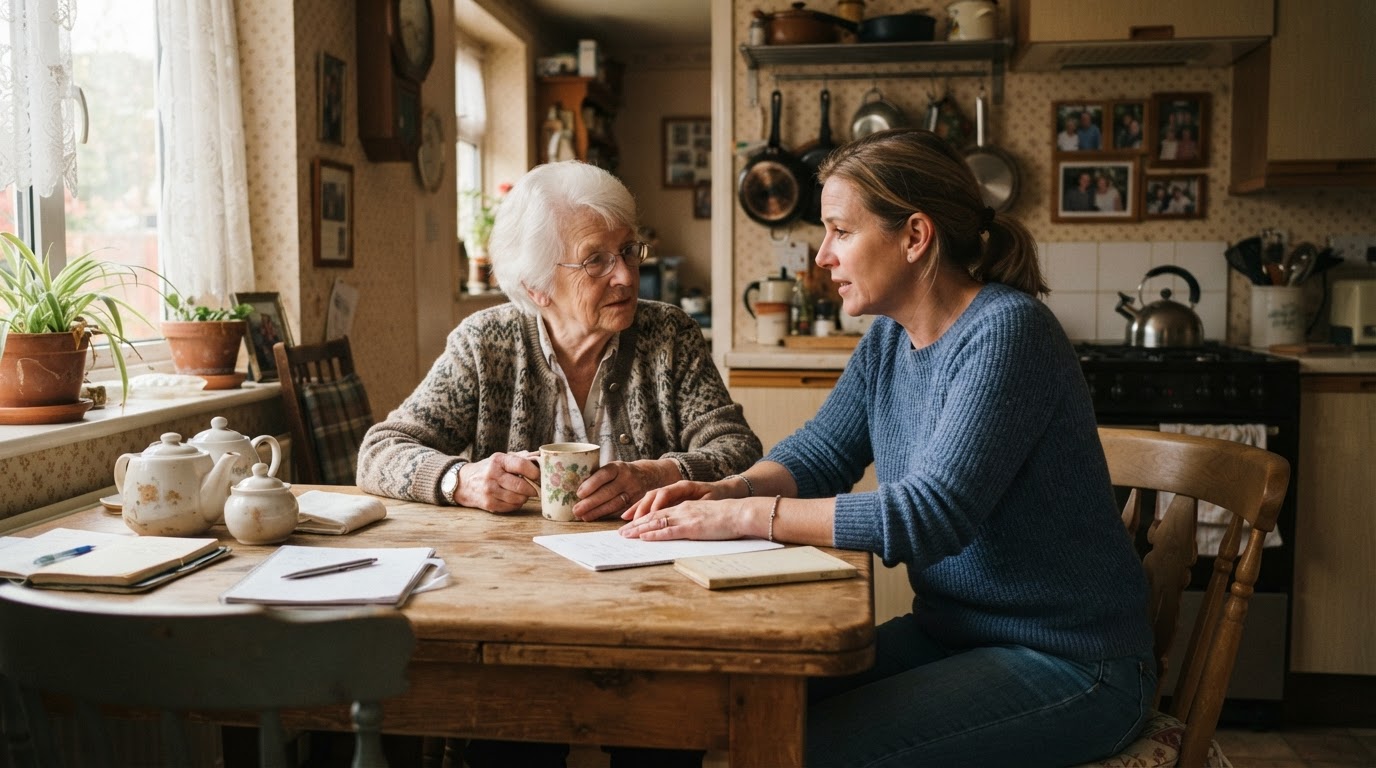
It rarely begins as a property decision. More often, it starts with a small worry. A parent mentions that the stairs seem longer than they used to. A sibling notices the lawn hasn't been mowed. A fall, a close call, or a hospital stay reframes a home everyone took for granted. At some point, a parent's home stops being just their home and becomes something the whole family is thinking about.
The tension between worry and independence
An adult child's concern usually comes from love. A parent's resistance usually comes from the same place. The house isn't only where they live — it's where they raised a family, kept a garden, built a routine, and maintained an identity that has nothing to do with square footage. When a family member suggests that the home may no longer fit, it can sound less like care and more like a threat to everything that home represents.
That tension is normal, and it's worth naming. The goal of a family conversation is not to win an argument about whether a parent should move. It's to understand what the household is actually dealing with — and what would make the situation safer, more sustainable, or more comfortable without taking decisions away from the person whose life they affect.
What a family is usually trying to understand
When a parent's home becomes a family concern, the questions tend to fall into a few overlapping areas, each with its own property implications.
Safety and the physical environment
Stairs, lighting, flooring, bathrooms, and entryways can all change how safely a home functions as needs evolve. The Centers for Disease Control and Prevention identifies falls as the leading cause of injury among adults age 65 and older. The National Institute on Aging offers practical guidance — improved lighting, secured rugs, grab bars, and nonslip surfaces — for reducing fall risks at home. Understanding which risks are reasonable to address and which reflect a deeper mismatch between the home and the person is often the first practical question.
Maintenance and daily demands
A home that was manageable for decades can become quietly demanding. Roofs, yards, systems, and seasonal upkeep all require attention, money, and physical effort. The question isn't whether the work is technically possible — it's whether the ongoing demands are sustainable, and whether outside help, simpler arrangements, or a different property would change that calculus.
Proximity and support
A parent's home may be perfectly comfortable in isolation. But if adult children live across the country, if healthcare access requires a long drive, or if a spouse who handled half the household is no longer there, the location itself can become a constraint. The property decision may be less about the house and more about whether the place still supports the life around it.
Helping without deciding for someone
One of the hardest parts of these situations is that the person most affected — the parent — may not see the situation the same way the family does. And they may be right. A house that seems too large or too demanding to a visiting child may be exactly what makes daily life feel grounded and familiar to the person living in it.
A more useful frame is to separate the concerns from the solutions. Instead of starting with a conclusion — 'you should move' — start with the underlying worries. Is the concern about stairs? About isolation? About the cost of upkeep? About what happens if a health change occurs? Different worries suggest different responses, and not all of them require a sale.
“The question is rarely whether to move. It's what would make staying possible — and whether staying would continue to serve the person living there.”
Some possibilities a family might explore
Once the actual concerns are clear, several directions may be worth discussing — together, not unilaterally.
- Targeted accessibility improvements — grab bars, lighting, a stairlift, or a first-floor arrangement — that let a parent stay in a familiar place longer.
- Outside services for maintenance, yard care, or in-home support that reduce the daily demands without changing the address.
- A change in how the home is used — converting a room, reducing clutter, or reorganizing — rather than leaving.
- A move closer to family or to a more suitable property, with the financial and emotional costs of a transition weighed honestly.
- Professional input — an occupational therapist, a geriatric care manager, or a qualified advisor — to help the family understand what's realistic before anyone commits to a path.
None of these is automatically right, and most aren't mutually exclusive. A family might begin with modest safety improvements while honestly assessing whether a larger move makes sense over a longer horizon. The point is to preserve the parent's choices as long as those choices remain genuinely workable — and to plan ahead enough that an urgent situation doesn't force a rushed one.
The financial picture belongs in the conversation
These decisions also carry financial dimensions that a parent may not want to discuss but that shape what's possible. A long-held home may carry substantial equity. That equity could support accessibility improvements, fund a transition, or provide flexibility — but accessing it through a loan or a sale introduces costs and obligations. Property taxes, insurance, upkeep, and the cost of any replacement home all matter. And a smaller house does not always mean a less expensive life.
Talking about money early — rather than after a crisis — can keep a family from mistaking a financial problem for a care problem, or vice versa. It can also clarify which options are realistic and which require more planning.
When the timeline changes
Many of these situations simmer for years before something makes them urgent. A fall, a hospitalization, the loss of a spouse, or a change in finances can compress a decision that could have been considered gradually into one that has to happen quickly. Under that pressure, choices narrow. There's less time to compare options, prepare a property, arrange financing, or coordinate a family. Understanding the landscape before that moment — not the answer, just the landscape — is one of the most useful things a family can do.
None of this means a parent should move before they're ready. It means the earlier a family understands what's changing, what the home can support, and what the options are, the more choices tend to remain available when it matters.
Questions a family can ask together
- What specifically has become harder — and for whom?
- Can those challenges be addressed in the existing home, and for how long?
- What does the parent most want to preserve — independence, the neighborhood, the memories, the routine?
- What would each option require in time, money, and disruption?
- What would we want to have figured out before a situation becomes urgent?
These conversations are rarely easy. But they're easier than the ones families have after a decision has already been forced. And they're more respectful when the person whose home it is stays at the center of them.
This article provides general educational information, not individualized healthcare, legal, tax, or financial advice. Safety, accessibility, and property decisions should be evaluated with appropriately qualified professionals based on individual circumstances.
A Guide for the Conversation the Whole Family Shares.
When a property decision belongs to more than one person, the conversation is the work. This guide organizes the questions a family faces when several adults share a decision about a home — who has a say, what each person needs, the money picture, how you talk together, and how a decision actually gets made. Check off what you’ve talked through, add notes, and download or print a clean copy to bring to the conversation. Nothing you enter is sent or stored.
Family Communication Guide
Coordinating Expectations Across Adult Family Members
When a property decision belongs to more than one person, the conversation is the work. This guide organizes the questions a family faces when several adults share a decision about a home — who has a say, what each person needs, the money picture, how you talk together, and how a decision actually gets made. It's an organizing tool, not a determination of what anyone should do.
Bring it to the family
Download or print a clean copy of this guide — with your notes and checkmarks — to bring to a family conversation. Nothing is sent or stored; the file is created in your browser.
Progress
0 / 22
prompts you’ve talked through. The goal isn’t to finish every item — it’s to surface what matters before the family commits to a path.
What this guide is — and isn’t
This guide provides general educational information, not individualized legal, tax, estate-planning, or real estate advice. Ownership, probate, and property decisions should be evaluated with appropriately qualified professionals based on individual circumstances.
Companion to: When an Inherited Home Becomes a Family Decision
Related paths
These Jumpcity capabilities may be relevant to this situation.
AI tools were used in preparing this article. Jumpcity is responsible for its published content.
Continue exploring
Guides & Tools for Your Next Step.
Explore practical resources to understand your options, compare tradeoffs, and prepare for what comes next.
Helping a Parent With Their Next Move
Explore a parent's housing preferences, support needs, property responsibilities, and family considerations before planning their next move.
Read the GuideFamily Transition Planner
Center the parent's preferences, responsibilities, and timing in one shared place.
Open the PlannerSale Readiness Planner
Organize the decisions, documents, preparation tasks, and timing involved in getting a home ready to sell.
Open the PlannerProperty Readiness Audit
Identify property conditions, access needs, missing information, and questions requiring professional review before deciding what comes next.
Open the ChecklistRelated insights
When the Home You Love No Longer Fits the Life You're Living
The home that once made life easier can gradually become harder to live in. When that happens, the question isn't always whether to sell — it's whether the home can continue supporting the life you want to live.
When an Inherited Home Becomes a Family Decision
An inherited property often becomes a question for everyone who shares it. Ownership, memories, costs, and different ideas about the future all arrive at once — and the first useful step is rarely a sale.
Why a Changing Life Doesn't Always Mean Selling Your Home
When circumstances change, selling is often presented as the default. But it's one option among several — and understanding the alternatives is what turns a reaction into a decision. Selling is a choice, not an inevitability.
Useful context is worth sharing.
Not sure which path fits your situation?
What Happens After You Start
You share your situation. Complete the assessment — about three minutes, no obligation.
A person reviews it. Someone at Jumpcity reads what you shared to understand your goals.
We follow up with context. We reach out with relevant options and an appropriate next step.
A short, guided assessment · No obligation
A Path for Every Move.