
Life & Property
When a Family Wants to Live Closer Together
The decision to move closer to family is rarely just about distance. It's about support, time, the shape of daily life — and what each household is willing to change to be nearer. Before the move, it's worth understanding what closeness would actually require.
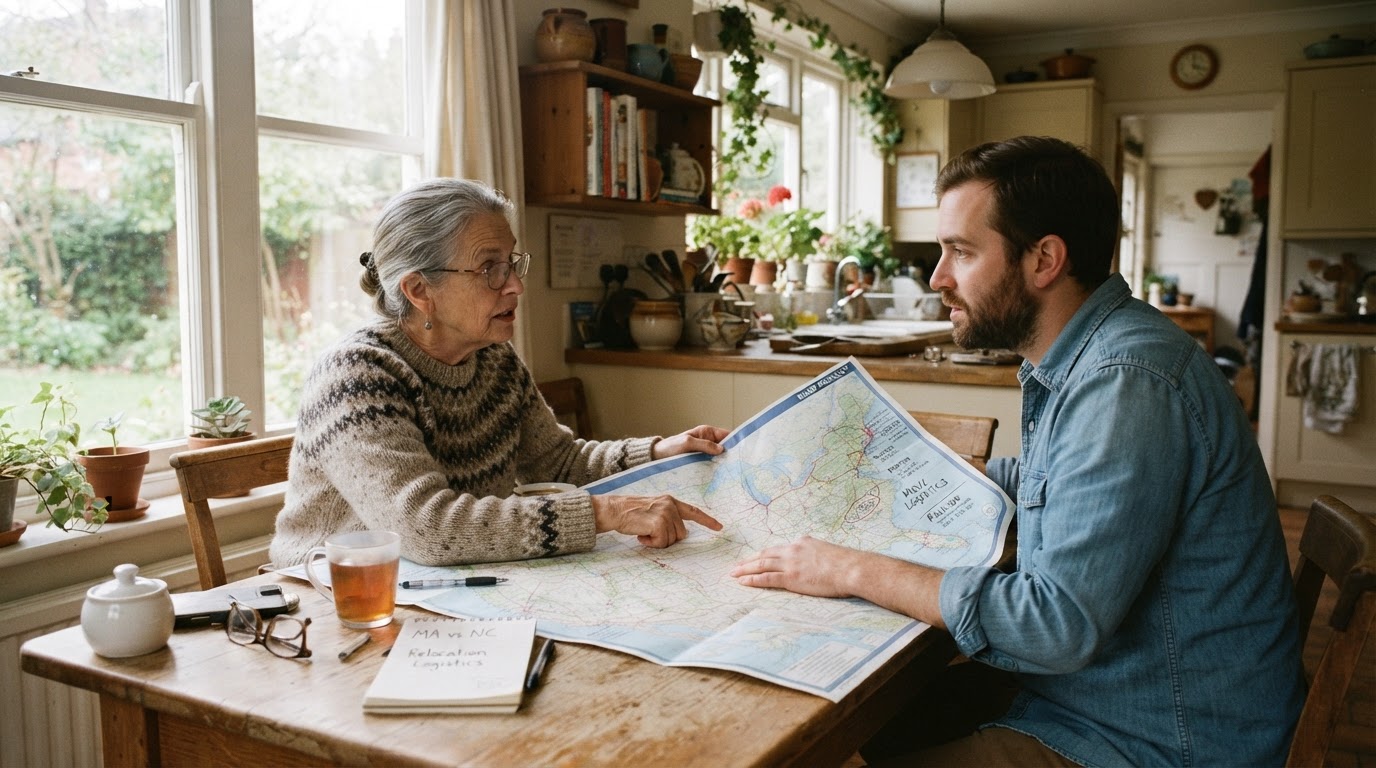
The pull toward family is one of the most common reasons a household considers a move — and one of the most misunderstood, because it sounds simple. A parent wants to be nearer to grown children. Adult children want to be closer to an aging parent. Siblings scattered across states begin to wonder whether being in the same place would make everything easier. And it might. But the decision to move closer to family is rarely just about distance. It's about what closeness would actually provide, what it would cost, and what each household is willing to change — about its home, its community, its finances — to get it. Before the move, it's worth understanding what the move is really for.
What closeness is actually solving for
The useful first question isn't 'how do we move closer' but 'what are we trying to be closer for.' The answers vary, and they shape the right response. Is it daily support — helping with meals, errands, appointments, the ordinary needs that add up? Is it presence for the moments that matter — holidays, milestones, the ordinary texture of shared life? Is it a safety net — being near enough to respond if something changes? Or is it something less tangible — a sense of belonging, of rootedness, of not doing the hard parts alone? Different answers suggest different arrangements. A move that provides a safety net but disrupts a life that was already working may solve one problem and create another. The honest version of the decision starts with what closeness is actually meant to provide.
What the move would actually require
Living closer together is a decision for more than one household, and it's worth recognizing that. A parent moving to be near adult children may be leaving a community, a home, and a rootedness built over decades. Adult children moving toward a parent may be uprooting their own household — a job, a school district, a cost of living — for a benefit that's partly theirs and partly someone else's. And the household being moved toward may have its own constraints: space, time, the limits of what closeness can actually provide. A move that works for one generation and burdens another isn't automatically the right one, and a closeness that comes at the cost of the life it was meant to support can be self-defeating. The decision is shared, and it deserves to be made as a shared one.
The cost, in more than dollars
A relocation toward family carries the usual costs of a move — transaction expenses, the price of a new home, new property taxes — and it can also carry a change in cost of living that reshapes the household's finances in both directions. Moving from a lower-cost area to a higher-cost one to be near family can strain a retirement income; moving the other way can ease it. But the harder costs are the ones that don't show up on a statement: the community left behind, the routine disrupted, the identity tied to a place. For some households, those costs are worth what closeness provides. For others, they're not, and a different arrangement — visits, support services, a move for one generation but not the other — turns out to be the better answer. The useful comparison weighs the life the move would build against the life it would leave behind.
“Closeness isn't only a matter of miles. It's a matter of what those miles would provide — and what they'd cost the lives they're meant to bring together.”
When closeness isn't the same as a move
It's worth holding the possibility that the right answer isn't a relocation at all. Sometimes what a family needs — support, presence, a safety net — can be provided without anyone leaving their home: through in-home services, through more frequent visits, through the slower work of building a support network where each household already is. And sometimes the honest answer is that the move would provide something the family wants without solving the problem it was meant to solve, and recognizing that before the boxes are packed saves a harder conversation after. The question is what the family is actually trying to accomplish, and whether a move is the way to accomplish it — or whether it's the most visible answer to a question that has a better one.
Questions worth asking as a family
- What is the family actually trying to be closer for — daily support, presence, a safety net, or something less tangible?
- What would each household — the one moving and the one being moved toward — have to change, and is that change sustainable for both?
- What would the move cost in dollars, in community, and in the life it would leave behind — and does what it provides justify that?
- Could any of what the family needs be provided without a relocation, through services, visits, or a different arrangement?
- If the move happens, what would make it work for everyone involved — not just the household with the need, but the ones accommodating it?
This article provides general educational information, not individualized financial, tax, or real estate advice. Relocation and family decisions should be evaluated with appropriately qualified professionals based on individual circumstances.
A Worksheet for the Household You’re Considering.
Before a shared household settles in, the practical questions are easier to answer than after. Use this worksheet to organize what each person needs from the space, how the household’s costs would be shared, and which questions are still open. Nothing you enter is sent or stored — it stays on this page for you to think with.
Household Space & Expenses Worksheet
Organize the practical questions a shared household raises — space and privacy, shared expenses, and the open questions worth naming before the arrangement settles in. Organizational only; nothing is sent or stored.
Your worksheet
Updates as you enter values. Nothing is sent or stored.
Estimated monthly shared expenses
$0/mo
0 of 0 expenses entered. Your estimates — not a budget or a determination of what anyone can afford.
Space & privacy
0 needs
0 essential · 0 important
Open questions
0 open
0 resolved · 0 discussing
What this worksheet is — and isn't
An organizing tool, not a determination of affordability, ownership, capacity, or authority. The expense figures are your estimates, not a verified budget. Space needs reflect what matters to your household, not what any particular property can provide. Housing, financial, and care decisions deserve appropriately qualified professionals — this worksheet helps you arrive at those conversations organized.
Related paths
These Jumpcity capabilities may be relevant to this situation.
AI tools were used in preparing this article. Jumpcity is responsible for its published content.
Continue exploring
Guides & Tools for Your Next Step.
Explore practical resources to understand your options, compare tradeoffs, and prepare for what comes next.
Planning a Move Between States
Understand how your current home, next home, financing, and timing connect when a move crosses state lines — and how to approach the decisions without assuming a sale or a sequence.
Read the GuideMove Timeline Builder
Generate a suggested planning sequence back from a target move date you choose.
Build Your TimelineFamily Transition Planner
Center the parent's preferences, responsibilities, and timing in one shared place.
Open the PlannerTotal Move Budget Estimator
Estimate movers, packing, storage, travel, temporary housing, and setup costs. Add a contingency to understand your total moving budget.
Estimate Moving CostsRelated insights
When a Job Change Reshapes Where a Family Lives
A new opportunity can mean a new city, a longer commute, or a different kind of life. Before the offer becomes a move, it's worth weighing what the relocation actually costs — and what the current home is actually holding.
When an Aging Parent's Home Becomes a Family Concern
It often starts with a small worry — a fall, a cluttered stairway, a house that's harder to keep up. How can a family help while respecting a parent's independence and the home they've built?
When the Home You Love No Longer Fits the Life You're Living
The home that once made life easier can gradually become harder to live in. When that happens, the question isn't always whether to sell — it's whether the home can continue supporting the life you want to live.
Useful context is worth sharing.
Not sure which path fits your situation?
What Happens After You Start
You share your situation. Complete the assessment — about three minutes, no obligation.
A person reviews it. Someone at Jumpcity reads what you shared to understand your goals.
We follow up with context. We reach out with relevant options and an appropriate next step.
A short, guided assessment · No obligation
A Path for Every Move.