
Life & Property
The Family Home After the Children Leave
When the last child moves out, the home that was built around a full household starts asking different questions. Some are practical — space, cost, upkeep. Others are about what the home is now for.
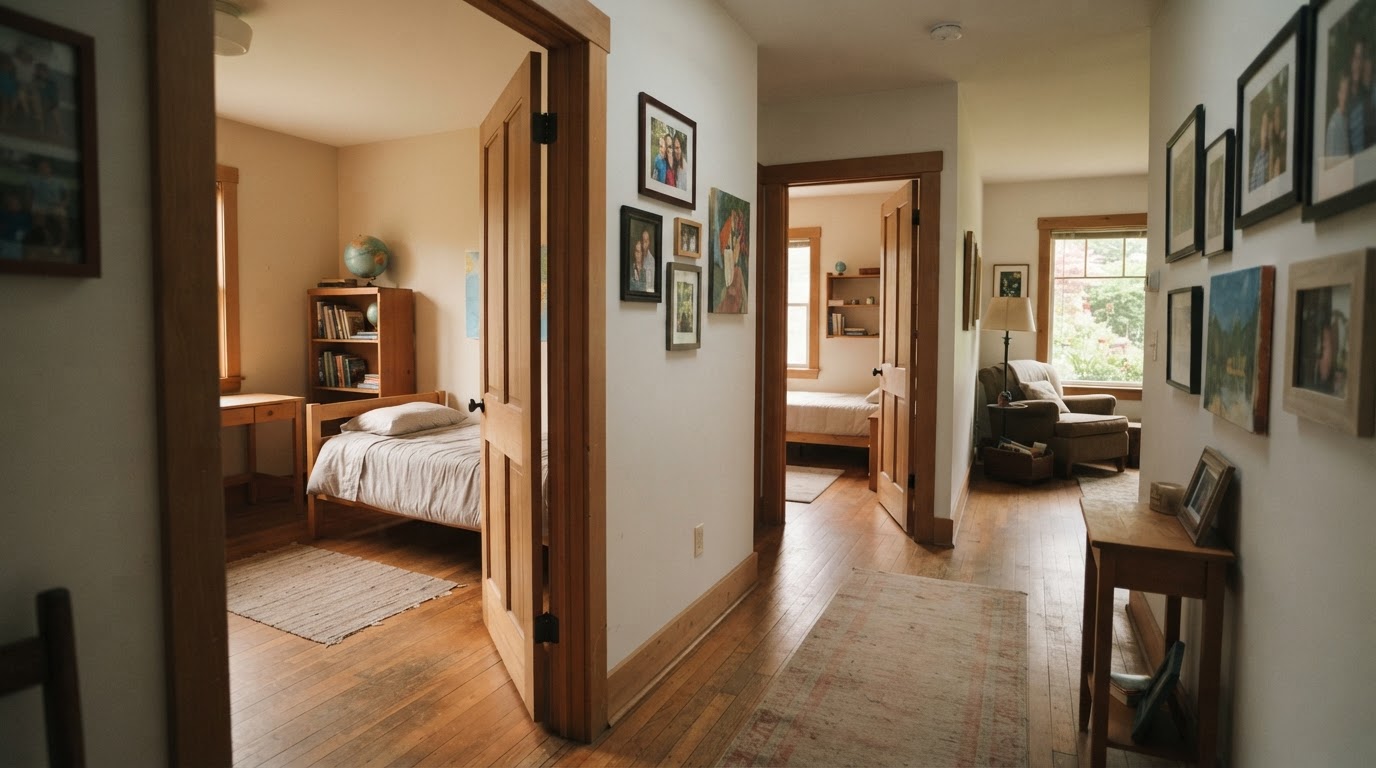
It happens the way most household changes do — gradually, and then all at once. A bedroom stops being occupied every night. A bathroom goes unused. The kitchen, built around a family's routines, starts to feel oversized for the people actually in it. The home that was, for years, the center of a full household becomes a home that holds two people in a layout designed for more. The empty-nest transition is often described as a loss, and it can be — but it's also, more usefully, a question: what is this home now for, and does it still serve the people living in it?
The space changes meaning before it changes size
The first thing that shifts isn't the house — it's the household's relationship to it. Rooms that were essential become optional. A yard that was the setting for a childhood becomes a maintenance list. A layout that organized a family now organizes two people across more space than they use. None of that is a problem in itself. But it's worth noticing, because the home that fit a family may not be the home that fits the life that comes after it — and the right response isn't always a smaller one. Sometimes it's a different use of the same space. Sometimes it's a different location. And sometimes it's staying, and letting the home settle into a new purpose.
The cost of more than you need
A larger home carries larger ongoing costs — property taxes, insurance, utilities, upkeep — that may weigh differently against a household whose income or time has shifted. A yard that was a pleasure to maintain when it was in constant use may become a burden when it isn't. Rooms that are heated, cooled, and taxed but not lived in still cost what they cost. For some empty-nesters, that's a fair price for a home they love. For others, it's a quiet drain that makes a different arrangement worth considering. The useful question isn't whether the home is too big in the abstract. It's whether the cost and effort it asks still match what it gives back.
What the home still holds
There's also the matter of what a longtime home holds that isn't on any balance sheet. The marks on a doorframe tracking a child's height. The room where a family gathered. The neighborhood, the routine, the rootedness that accumulates over decades. For some homeowners, that weight is a reason to stay — the home becomes a different kind of center, one built around a smaller, quieter life rather than a full one. For others, it becomes the thing that makes staying feel like staying in the past. Neither is wrong. The honest version of the decision accounts for what the home means, not only what it costs.
“An empty nest isn't an empty home. It's a home that's ready to hold a different life — and the question is which one, and where.”
The options, without a default answer
- Stay, and let the home settle into a quieter purpose — using the space differently rather than leaving it.
- Adapt — reconfigure, repurpose, or right-size within the same home rather than abandoning it.
- Move closer to grown children, to a preferred community, or to a property that asks less and gives more of what the next chapter wants.
- Hold for a season — the first months of an empty nest are a difficult time to make a permanent decision, and waiting is a legitimate choice.
None of these is the 'right' answer. The right one is the one that fits the household — its finances, its energy, its relationships, and the life it actually wants to build next. A sale is one option. It's not the only one, and it's rarely the first one to reach for.
Questions worth asking
- What does the home cost to carry now, and does that still fit the household's finances and time?
- Which rooms are still used, and which are costing effort without giving much in return?
- What does the household want the next chapter to be built around — and does this home support it or get in its way?
- Could the home be adapted to fit a smaller household better, or is a different property the more honest answer?
- Is now the right time to decide, or is it a season to wait and see how the new shape of the household settles?
This article provides general educational information, not individualized financial, tax, or real estate advice. Downsizing, maintenance, and relocation decisions should be evaluated with appropriately qualified professionals based on individual circumstances.
Related paths
These Jumpcity capabilities may be relevant to this situation.
AI tools were used in preparing this article. Jumpcity is responsible for its published content.
Continue exploring
Guides & Tools for Your Next Step.
Explore practical resources to understand your options, compare tradeoffs, and prepare for what comes next.
Downsizing Cost Comparison
Compare current and next-home ownership costs, estimated sale proceeds, purchase expenses, and cash remaining after a modeled move.
Compare OptionsIs It Time to Downsize?
Explore lifestyle fit, housing expenses, and the difference between equity and cash after a move.
Read the GuideKeep-or-Sell Scenario Worksheet
Compare what selling your property could make available today with what keeping it might require — and potentially produce — over time. Rental cash flow, estimated equity, and estimated sale proceeds are shown as three different measures.
Open the WorksheetSale Readiness Planner
Organize the decisions, documents, preparation tasks, and timing involved in getting a home ready to sell.
Open the PlannerRelated insights
When Downsizing Is About More Than Square Footage
Downsizing is often treated as a math problem — fewer rooms, smaller payment. But the homeowners considering it are usually after something less measurable: freedom, simplicity, proximity, or a life that fits differently.
When the Home You Love No Longer Fits the Life You're Living
The home that once made life easier can gradually become harder to live in. When that happens, the question isn't always whether to sell — it's whether the home can continue supporting the life you want to live.
When an Inherited Home Becomes a Family Decision
An inherited property often becomes a question for everyone who shares it. Ownership, memories, costs, and different ideas about the future all arrive at once — and the first useful step is rarely a sale.
Useful context is worth sharing.
Not sure which path fits your situation?
What Happens After You Start
You share your situation. Complete the assessment — about three minutes, no obligation.
A person reviews it. Someone at Jumpcity reads what you shared to understand your goals.
We follow up with context. We reach out with relevant options and an appropriate next step.
A short, guided assessment · No obligation
A Path for Every Move.