
Housing & Markets
A traditional sale vs. an offer: what are you actually trading?
Price is only one variable. Timing, certainty, condition, and what happens next all shape what an offer is really worth. Here's how to think about the whole exchange.
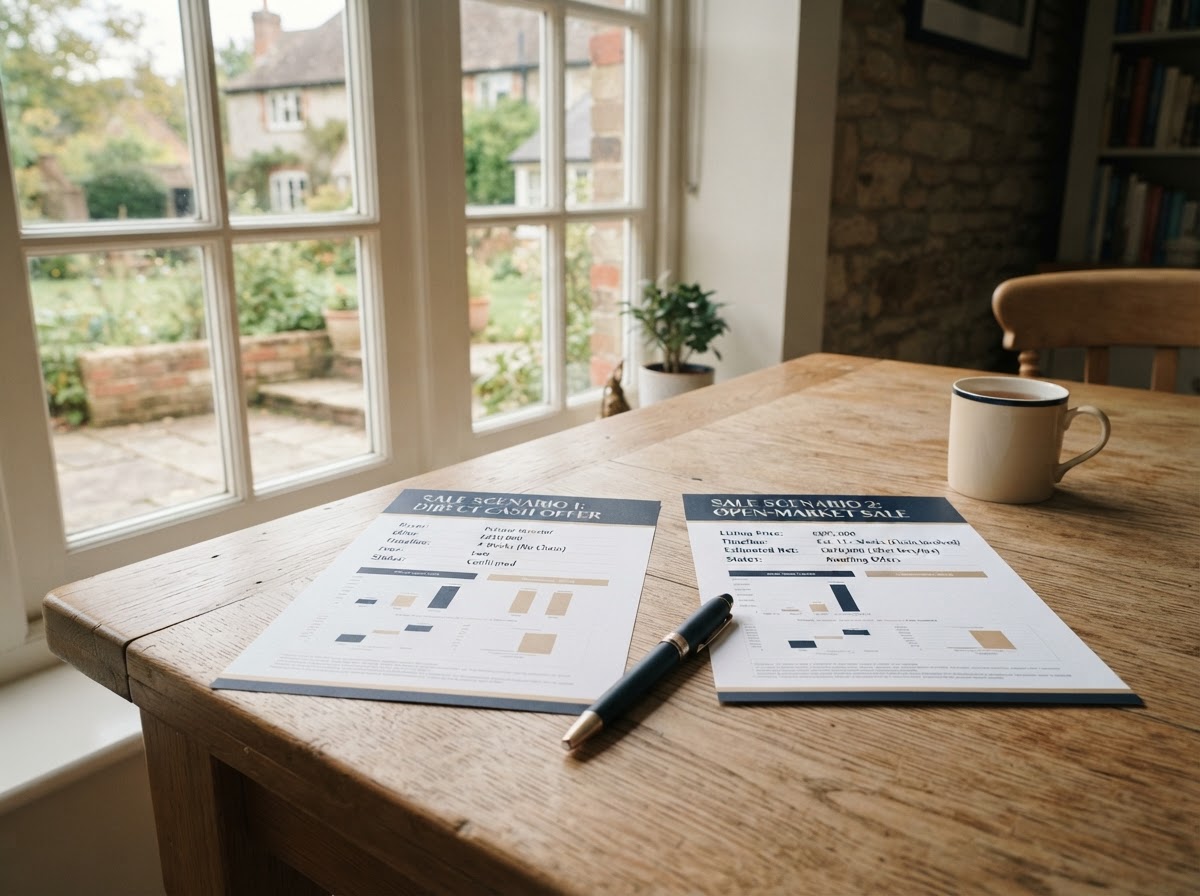
When homeowners compare a traditional sale with a direct or alternative offer, the conversation usually narrows to a single number. But a headline price doesn't tell you what you're giving up to get it — or what you're gaining in exchange. The useful question is broader: what is each path actually solving for?
More than one variable
An offer is a package of terms, not just a price. The closing timeline, contingencies, repair expectations, showings, and certainty of closing all change what the offer is worth to you in practice. Two offers at the same number can mean very different things.
What the open market optimizes for
- Broader buyer exposure and competitive price discovery.
- Potential for stronger pricing when the property and timing align.
- Conventional representation and marketing.
- But also: preparation, showings, contingencies, and less certain timing.
What a direct offer can optimize for
- Greater simplicity and reduced preparation.
- Potentially more flexible or certain timing.
- An as-is path when condition or occupancy make showings difficult.
- But also: less market exposure and different terms to weigh.
Neither path is automatically better
The better question is which tradeoffs fit what you're trying to accomplish. A homeowner who values certainty and a clean exit may find an offer worth the difference in price. A homeowner with time and a marketable property may find that exposure pays for the effort. Both can be right.
“An offer is only useful when you understand what you're trading for it.”
Understanding the whole exchange — value, time, certainty, effort, and what comes next — is what makes the decision yours rather than someone else's.
Related paths
These Jumpcity capabilities may be relevant to this situation.
AI tools were used in preparing this article. Jumpcity is responsible for its published content.
Continue exploring
Guides & Tools for Your Next Step.
Explore practical resources to understand your options, compare tradeoffs, and prepare for what comes next.
Cash Offer or Open-Market Sale?
Compare two sale scenarios across estimated proceeds, timing, preparation, and terms.
Read the GuideSale Options Comparison
Compare two sale scenarios you enter across proceeds, timing, preparation, and terms.
Compare OptionsHow to Compare Home Offers
A higher offer isn't always the better outcome. Learn how to evaluate price, estimated proceeds, financing, contingencies, closing dates, and possession before deciding.
Read the GuideOffer Comparison Worksheet
Compare several offers across price, seller expenses, closing date, contingencies, and possession.
Open the WorksheetRelated insights
You inherited a home. What should you consider first?
An inherited property often raises questions that have nothing to do with selling. Ownership, condition, and family dynamics usually deserve attention before any transaction path becomes clear.
When the Housing Market Makes Moving Harder, the Decision Matters More
A difficult housing market doesn't affect every household the same way. For some it changes the timing of a move; for others it changes whether moving makes sense at all. Here's how to think about the decision when the market makes it harder.
Why the Best Property Decision Isn't Always the Most Profitable One
The most profitable sale is not always the best decision. Sometimes the right move accepts a lower return in exchange for certainty, timing, or a life that fits better — and the best decision serves the household, not the spreadsheet.
Useful context is worth sharing.
Not sure which path fits your situation?
What Happens After You Start
You share your situation. Complete the assessment — about three minutes, no obligation.
A person reviews it. Someone at Jumpcity reads what you shared to understand your goals.
We follow up with context. We reach out with relevant options and an appropriate next step.
A short, guided assessment · No obligation
A Path for Every Move.